Oxford Academy School District Prepares For Hearing On 2026-27 Proposed Budget
Published:
May 4th, 2026
By:
Rebecca Laibowitz
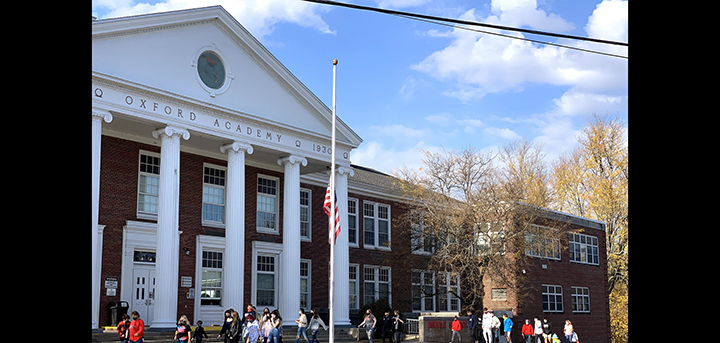 The Oxford Academy Central School District will have its public budget hearing tomorrow, Tuesday, May 5. The budget vote takes place on Tuesday, May 19. There are four propositions for voters to decide on. (Photo taken from Facebook)
OXFORD – On Tuesday, May 5 there will be a public hearing on the Oxford Academy Central School District 2026-2027 budget proposal. Following the hearing, taxpayers in the district are invited to vote on the budget proposal on Tuesday May 19.
The proposed budget and costs
The total proposed budget for the 2026-2027 school year is $25,541,436, a 6.28% increase from the previous year, with a tax levy increase of 2.7%.
According to Superintendent Nicholas Colosi the estimated tax impact is approximately $3,676 per $100,000 of assessed property value in all of the townships.
The highest reported expenditure is on employee benefits, health insurance, and retirement projected at $7,827,675 for the 2026-2027 school year while in the previous year's budget it was $6,507,283.
“The biggest piece of our budget going up, would be increased costs for health insurance for the district. It was a huge increase. We had a 17.25% increase, and that accounted for the majority of the rising costs to the budget,” said Colosi.
While the costs of benefits has increased, the district has been able to save a little bit of money on total salaries and administrative costs. The 2025-2026 budget had $1,839,874 for support salaries, and $6,491,862, for instructional salaries. The 2026-2027 budget projects $1,711,739 for support and $6,354,786 for instructional salaries. From the district's budget presentation, expenditure on Administrative components of the budget is projected to decrease by 3.56% in the upcoming year from $2,806,319, to $2,706,284.
According to Superintendent Colosi, they found savings as staff was reduced through attrition, “right-sizing” staffing based on student enrollments and balancing that with programming needs.
He also relayed that the district did do a retirement incentive last year, which helped get costs down across the district. Colosi explained that, “when you get new personnel in, they're usually hired with less experience, and come at a lower cost than their predecessors, who might've been there for years.”
The district reports a staffing for 2026-2027 school year at 85 certified teaching/licensed staff and 74 student support staff for 159 total staff members. Notably, the district has created a permanent full-time occupational therapist position for its contracted overtime, included in the budget, to make it an in-house position. Colosi relayed that they do not have a specific dollar amount yet but it's going to be competitive to what they're currently paying, area standards, and what other districts pay similar roles.
Colosi mentioned that the majority of the budget is funded through state aid, which they've projected to be $18,220,484 for the upcoming school year. However the state has not yet finalized the state budget, making it a slight challenge to create the 2026-2027 school budget.
“We plan for the worst, hope for the best. So we're planning for the lesser number,” said Colosi who earlier said that the rising costs on everything have a great impact on the budget, as many things are rising at a faster pace than State aid is given. He said he believes most districts in the area are in a similar situation, where they rely heavily on state aid and faced with rising costs. Coloi said, “we try to make staffing decisions, and look at other ways to generate more revenue or how to curtail some spending so that we can kind of keep things more of a status quo and maintain what we have. Luckily, we've been able to do that without any huge impact on students.”
Other propositions to be voted on
Proposition I on the ballot is obviously to approve the annual budget in the amount of $25,541,436, but there are three other propositions to be voted on at the election on May 19 as well.
Proposition II involves purchasing of two diesel powered student transportation vehicles.
Superintendent Colosi explained that the district has a purchasing schedule for buses so it's a constant proposition year to year to keep the fleet updated.
This year proposition II asks voters to authorize the purchase of one 42-passenger diesel school bus with wheel chair package at a maximum estimated cost of $205,917 and one 65-passenger diesel school bus at a maximum estimated cost of $179,904 for a total combined maximum estimated expenditure of $385,821.
Colosi explained that this is the final year that schools are allowed to buy diesel buses as new laws move schools toward zero-emission fleets statewide. He said they want to take advantage of this final opportunity to purchase diesel powered vehicles.
Since the purchasing of vehicles in on a schedule, the district is able to work these purchases into its debt service. Which Colosi explained means that as some debt is paid off, they can replace it with new debt, maintaining stability and preventing large changes in tax impact from year to year.
Proposition III surrounds the purchasing a zero-emissions student transportation vehicle.
It asks if voters wish to authorize the purchase of one 66-passenger zero-emission school bus at a maximum estimated expenditure of $490,502.
Superintendent Colosi explained that the district worked with NYSERDA and a consultant company on a bus transportation study. NYSERDA also helped the district secure grant funding and rebates that would help lessen the costs of the zero-emission bus to make it closer to a what a diesel bust costs.
“Also, to meet the requirements set out through the legislature and through state ed, we have to move towards a zero- emission fleet. And obviously, the voters have to approve those expenditures,” said Colosi.
He went on to say that if does get approved, they have reimbursable funding to install a charger and rebates to offset some of the costs of the actual bus that has been worked into the districts debt service.
However, he also said that if the vote to purchase the zero-emission bus is not passed, that information will be used in an application waive the the zero-emission fleet requirement for the district for the time being. Voters denying the zero-emission vote at this time would show due-diligence and bolster the waiver application giving the school more time to transition according to Colosi. He added that the waiver application would be done around next March, making this the first opportunity to conduct a vote for an EV bus.
Proposition IV is the Oxford Memorial Library's annual appropriation.
“We do not set any of the numbers. We just have to put it on our vote. They have their own library board that determines what their tax increase will be, and so the increase they're requesting for the upcoming year will be $3,759 more, which would make the total amount that they're looking for $191,381. So again, usually those library budgets are included with the school budget vote, but we're just basically doing it for them based on the education law, but we have no control over that money or anything. We're just acting on their behalf,” said Colosi.
Voters are asked to authorize the annual library budget at the same time as the school district's budget in accordance with Education Law section 259.
Two board members up for reelection
In addition to the budget propositions, voters are also electing Board of Education members. There are two seats held by Julie Gates and Brian Sheridan, expiring on June 30, 2026. Those two current board members are running for reelection and no additional people have applied for their spots, unless there are write-ins. The positions being voted on will commence a 3-year term on July 1, 2026 an expire on June 30, 2029.
Author: Rebecca Laibowitz - More From This Author
Comments