Chenango County Warns Derelict Property Ordinances By Villages Could Trigger Tax Hit
Published:
August 5th, 2026
By:
Shawn Magrath
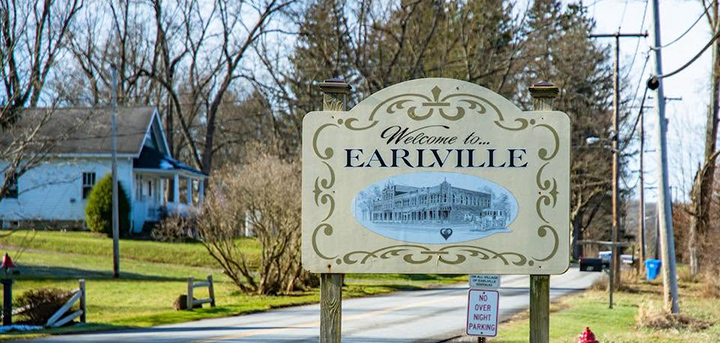 Chenango County officials are warning of the possible countywide tax impact of a newly adopted local law in the Village of Earlville. (Photo from Village of Earlville on Facebook)
EARLVILLE – A newly invoked ordinance in the Village of Earlville is facing criticism from Chenango County officials who argue that the village’s local law could have a countywide tax impact.
In July, the Village Board of Trustees adopted a local law penalizing property owners for neglected and abandoned buildings.
The law allows village officials to repair or demolish buildings deemed unsafe by code enforcement, then levy the cost against the property owner’s taxes.
Village leaders say the objective is to hold absentee proprietors accountable for derelict properties.
Earlville currently has one house that village officials are eyeing for demolition, located on the Madison County side of the village, just north of the Chenango County line.
“The greater issue is that houses like this are a public safety issue and a fire hazard, and what it does to neighboring properties because of how closely they’re located,” said Earlville Mayor Tom Taylor.
Although Earlville’s ordinance has good intent, the problem arises when unpaid delinquent taxes are returned to the county to settle, said Chenango County Attorney Zachary Wentworth.
By state law, the county is the tax enforcer for the 21 towns within its borders. But through a local law passed in 1978, the county elects to be the delinquent tax enforcer for villages in Chenango County as well, meaning county taxpayers bear the financial loss when a foreclosed property in a village goes to a tax sale and sells for less than the taxes owed.
The same goes for homes situated on the Chenango County side of the Village of Earlville.
When demolition expenses are levied against property taxes and the property owner fails to pay, those costs are then shouldered by the county. And there’s very little chance of selling a tiny parcel of land in a village for the roughly $10,000 to $20,000 it could cost to demolish a home, likely resulting in a financial hit for the county.
“Other than the neighbor who might want to expand their lawn parcel, it’s unlikely that we would be able to sell a property that size for $20,000 at a tax sale, so we lose money,” said Wentworth. “We know these village properties are probably going to take a loss, and a good-size loss. The problem is we’re going to pay out money for these houses to be torn down while having very little control over how many houses get torn down and re-levied.”
The prospect of financial loss is driving some county supervisors to reexamine the county’s option to enforce delinquent village taxes.
The county saw a $65,000 loss last year when the Village of Oxford, which passed an ordinance similar to Earlville's, razed two tax-delinquent properties and levied the cost against the tax bills. When the property owner failed to pay, the county was on the hook.
As more villages adopt similar ordinances, Wentworth said there have been discussions between county board committees about possibly repealing the county’s self-imposed local law to enforce village taxes.
“In the Village of Earlville, a single demolition would most certainly triple the amount the county has traditionally paid to make the village whole,” Wentworth wrote in a letter to the village's Board of Trustees. “Enforcing village taxes is an option for the county. We are not required to enforce them, and we only do so by our 1978 local law pursuant to Real Property Tax Law, Section 1442.”
Wentworth said repealing the county’s local law would spare county taxpayers the added expense of demolition should villages pursue that course of action.
“In that instance, the villages would become responsible for their own tax enforcement. The county would not be making the villages whole, and village residents would then be on the hook for any loss should a property not sell for the amount of back taxes,” Wentworth said.
“Our hope is never to pass that bill on to the county,” Taylor said. “Our hope is that through working with property owners, we will be able to resolve the situation before it ever gets to that point.”
In a written statement, the Earlville Board of Trustees said it is aware of the challenges Chenango County is facing as it seeks a solution for abandoned buildings that pose a safety risk.
“After careful consideration, the Village Board voted to adopt this amendment to our local law,” the statement reads. “We would appreciate the opportunity to meet with the members of the County Board to discuss this issue further. The Village Board is committed to addressing this challenge in a collaborative manner and believes that working together will help us find effective solutions that benefit both the village and the county.”
Author: Shawn Magrath - More From This Author
Comments