Turkey Spotters Asked To Join The DEC's Summer Wild Turkey Sighting Survey
Published:
August 20th, 2026
By:
Rebecca Laibowitz
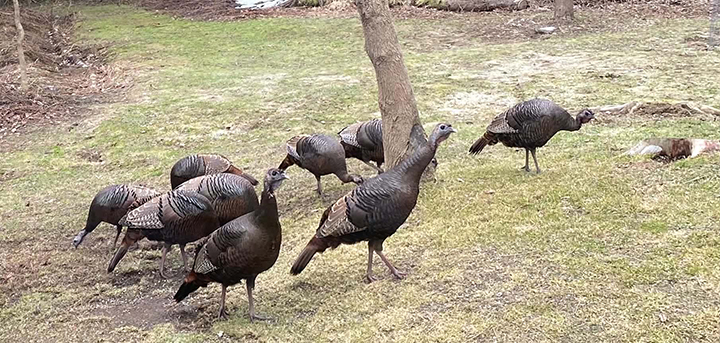 Wild turkeys spotted in a backyard in Chenango County. (Photos by Kelli Miller)
CHENANGO COUNTY - Each year since 1996, the New York State Department of Environmental Conservation (DEC) has invited the public to participate in the Summer Wild Turkey Survey to track wild turkey productivity statewide.
They are seeking to track the proportion of young turkeys, or poults, to adult hens statewide.
The survey takes place each August when citizens are asked to report sightings of turkey flocks, including the number of adult females, adult males, poults and unknown age/sex turkeys, with the date and location they were spotted.
DEC wildlife biologist Tom Cunningham said that the main reason DEC conducts the summer sighting survey during August is due to the poults and adults being easy to differentiate from one another.
Poults are turkeys that hatched this spring and are generally anywhere from dove-sized up to the size of a chicken, and much easier to separate out from the adult hens that are much larger during this time of year.
He mentioned that adult males are even larger, generally having darker body plumage, red or pink coloration on the head and neck area, and often having a noticeable “beard” on the lower neck/chest area; and that adult hens will typically have lighter brown body plumage and generally lack the red or pink coloration on their head/neck.
He noted that most hens lack beard feathers, though about 10% of hens may have them. In New York state, there is only one species of wild turkey, the Eastern Wild Turkey subspecies.
Cunningham said during August, the easiest places to view turkeys are in open fields, as thick vegetation often hides flocks from view while in the woods or other habitat types. “They can sometimes even be seen in residential areas and along roadsides,” he said.
“During August, citizens can expect to see turkeys in cut hay fields or other easily visible areas. The poults spend most of their time foraging for insects as they are high in protein and provide essential nutrients for feather development,” he added.
He explained that turkeys are considered “generalists,” meaning they will use many different types of habitat ranging from agricultural fields to mature forests. “Since they roost in trees at night, they generally aren't found too far from forest areas,” he said.
The data collected allow the DEC to estimate reproductive success and predict future turkey populations and harvest opportunities. According to recent DEC announcements, based on the results of this survey over the past decade, wild turkey reproductive success remains stable in New York.
“Turkeys are an important part of the food chain, as they are food to many different predators and scavengers alike. Turkeys also play an important role in dispersing plant and tree seeds through their foraging habits,” Cunningham said.
DEC Public Information Officer Lori Severino said, “This survey is a great way to partner with DEC to help monitor this popular game bird.”
The survey results also help predict what turkey hunting season will look like the following year.
“The summer sighting survey provides hunters with a general forecast of what the spring bird numbers will be like in the following spring,” said Cunningham.
“If the survey shows higher poults-per-hen averages than previous seasons, hunters can reasonably expect to see more turkeys on the landscape in the spring of 2027. The opposite is true if lower poult numbers are reported,” he added.
It also allows the DEC to gauge reproductive success each year and predict fall harvest potential.
Turkey behavior varies with the time of the year. Cunningham explained that turkeys are generally most noticeable from March-May during the breeding season, “when males strut to entice hens to mate.”
He said, “Post mating season turkeys tend to become harder to see until around August, when the poults are old enough to venture out into open areas with the adults more often. During the fall and winter months, turkey flocks will often combine to form larger ones as they find wintering habitat near mast producing trees or agricultural food sources.”
The DEC gives the following guidelines to those who wish to report flock sightings: Keep an eye out for wild turkeys as you’re out and about enjoying New York landscapes. When you observe any turkeys, simply record the number of adult females, adult males and poults (young of the year) that you see. When you’re at a computer or on your phone, please enter your observation in our digital survey form.
If you happen to see what you believe to be the same flock later in the month, please do not double report the group. Observing and counting wildlife can be challenging. To avoid biasing the results, we ask that you only report flocks when you’re confident you observed all turkeys present. Partial flock observations can bias the poult-per-hen estimates. Using binoculars can greatly improve the odds you’re able to observe an entire flock.
“The main thing to remember with any wild animal is to maintain a safe distance and maintain respect for that animal. Never feed or approach wild turkeys, as that can lead to negative interactions and develop bad behaviors for the turkeys.
Generally, DEC advises people to enjoy watching wild turkeys from a distance with the aid of binoculars or from inside cars or buildings. Due to their large size, turkeys can be a hazard on roadways, so it is advised to slow down when you see turkeys near a road to avoid spooking the birds and causing a collision,” Cunningham said.
Including the Summer Wild Turkey Sighting Survey, the DEC has four others in what it calls Citizen Science: Wildlife Observation Data Collection, which are the Furbearer Sighting Surveys, Grouse and Woodcock Hunting Log, New England Cottontail Survey and the Ruffed Grouse Drumming Survey. They also sometimes request volunteers to help with the Assessing Vegetation Impacts from Deer (AVID) initiative and for the Amphibian Migrations and Road Crossings, which requires some training.
“The summer turkey sighting survey is the perfect opportunity for citizens to collect and report important information that DEC uses to manage this important natural resource. For all the turkey hunters out there, DEC reminds everyone to report your spring and fall turkey harvests using the app or the online link found on DEC's website,” Cunningham said.
To report sightings, visit https://arcg.is/1HePbv0
To view results and trends from past surveys, visit https://experience.arcgis.com/experience/eeab1af0785b46a3905d9a7318186ba4/page/Page/?views=Summer-Poult-Survey
Author: Rebecca Laibowitz - More From This Author
Comments