Partial Solar Eclipse Visible Across New York State On Wednesday August 12
Published:
August 10th, 2026
By:
Rebecca Laibowitz
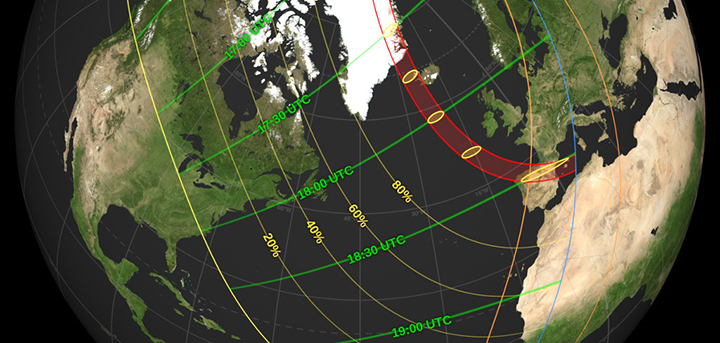 A global map of the shadow path for the August 12, 2026 total solar eclipse. (Photo taken from NASA https://svs.gsfc.nasa.gov/5647#media_group_380308 visualized by Ernie Wright and Produced by Sarah Frazier)
On Wednesday, August, 12, a partial solar eclipse will be visible in New York State. According to an eclipse map produced by NASA, Norwich is in the eclipse path with about 10% obscurity to be visible in the afternoon between 1 and 2:30 p.m. creating a view that NASA describes as the moon taking a “bite” out of the solar disk.
Despite it being only a partial eclipse visible at our location, caution is still necessary if you plan to view it; so yes, you need eclipse glasses to look at the sun safely.
It is never safe to look directly at the sun without proper eye protection. NASA recommends using solar eclipse glasses, that are thousands of times darker than ordinary sunglasses and ought to comply with the international standard ISO 12312-2. Camera lenses and telescopes also need filters, different than eclipse glasses, to view the eclipse through them safely. NASA recommends seeking expert advice from an astronomer before using a solar filter with a camera, telescope, binoculars, or any other optical device.
If you have eclipse glasses lying around from the solar eclipse in 2024, Wednesday would be a good day to bring them out again. NASA says to always inspect your eclipse glasses or viewer before you use them; if it's damaged, discard the device and don't use it.
If you do not have safe eye wear or a handheld solar viewer, NASA recommends using an indirect viewing method in which the image of the sun is projected onto a nearby surface. An example of this is a pinhole projector, which can be made easily at home with a cardboard box, white sheet of paper, tape, scissors, and aluminum foil. You can find instructions online.
During a total solar eclipse the moon completely obscures the view of the sun. The path of totality on Aug 12, begins in remote northern Siberia, then will pass over the Arctic Ocean and be visible across Greenland, Iceland, Portugal, and Spain. NASA says the path of this eclipse has a strong north-south component and is an example of the combined effect of the Earth's rotation, the tilt of Earth's axis, and the moon's orbit.
NASA will be live streaming the total eclipse online for those interested at www.nasa.gov/live starting at 1:15 p.m..
Author: Rebecca Laibowitz - More From This Author
Comments