Get An Inside Look At Law Enforcement: City Of Norwich Police Department Offers Free Community Class
Published:
December 18th, 2025
By:
Tyler Murphy
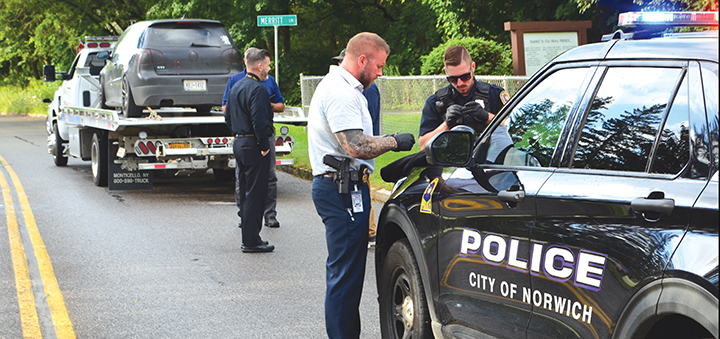 Norwich Police inspect suspicious substances following a traffic stop. The 2026 Civilian Police Academy begins on January 7, and runs for six weeks, meeting on Wednesday evenings from 6 to 8 p.m. An application can be found on Page 2 of today’s Evening Sun. (Photo by Tyler Murphy)
NORWICH — On any given day, a police officer’s shift may include an unpredictable range of typical tasks, like traffic enforcement, welfare checks, de-escalation of domestic disputes, a drug overdose, mental health calls, attending a community or school event, conducting a criminal investigation, or discovering an unattended death.
They comfort victims, confront perpetrators and, when duty demands, they are the first line of response in the most dangerous and complicated situations.
Even with practice, patience and a soft touch, it is impossible to always avoid breaking a sweat or getting your hands dirty. It’s a tough job.
Would you like to know how they do it?
Would you like to meet the real men and women who face these things every day in the Norwich community?
That wide scope of responsibility is what the City of Norwich Police Department hopes to share with residents through its free 2026 Civilian Police Academy, a six-week program designed to give community members an inside look at how policing works, from start to finish.
NPD Detective Samuel Stratton, who oversees the academy, said the program is about transparency and conversation.
“It’s a great opportunity for us to interact with the community and show people here within Norwich what it is that we do on a daily basis,” Stratton said. “People have an expectation for police, so we like to show them what we do every single day whenever a call comes in and how it goes from beginning to end.”
The Civilian Police Academy will share officers’ perspectives, the legal processes, and the day-to-day reality.
The 2026 Civilian Police Academy begins on January 7, and runs for six weeks, meeting on Wednesday evenings from 6 to 8 p.m. with each session focusing on a specific topic and hosting guest speakers.
The academy is open to anyone age 18 and older, and Stratton emphasized that there is no typical participant. Class size is limited to 15 students to allow for discussion and hands-on learning.
Applications must be submitted by Dec. 31 and are available at the Norwich Police Department. The course is limited to those who live or work in Chenango County. Applicants should complete the application and return it to the Norwich Police Department at 18 East Main Street, Norwich, or email the application to info@norwichpd.org.
The classes will be taught by NPD personnel with support from the Chenango County District Attorney’s Office.
Attendees will learn through a mix of classroom discussion and hands-on scenarios, including mock traffic stops, DWI investigations, searches and the arrest process. The course instructions will cover penal law and criminal procedure law, investigations, professional standards, community policing, the sex offender registry, evidence collection, and use-of-force demonstration.
Most participants are surprised to learn just how much decision-making and documentation happens behind the scenes.
“You'll see how we handle an arrest when it comes to dealing with a person,” Stratton said. “And the actual process, and all the steps you have to go through. And that we don’t resolve every problem with an arrest.”
He said the goal is problem-solving first.
“We actually like to try and resolve it without arresting somebody,” Stratton said. “We use de-escalation, our goal isn’t to arrest somebody. Our goal is to resolve the problem.”
Since it is a key part of being a police officer, de-escalation is a major focus of the academy, along with New York State’s Article 35 use-of-force law and how it applies in real-world situations.
Stratton said those topics often draw strong interest because residents can ask questions and see how policy and law connect to what officers do in the field.
Participants also learn the “life cycle of a call for service,” he said, from dispatch to response, report writing, and body camera handling.
At the end of the course, the academy concludes with a scenario-based exercise that brings together lessons learned throughout the six weeks.
The academy offers an optional active-attacker, reality-based training component for participants. Those taking part will have the chance to experience a simulated, unknown, active response, using a prop firearm and involving other officers performing the role of suspects, victims, and back-up.
The class will include a taser demonstration and offer daring participants a chance to experience the effect of a taser if they wish to volunteer. Several previous members voluntarily allowed themselves to be tased, which is a required part of a law enforcement officer’s expected training.
“All the stuff you’ve learned up to that point, we apply it,” Stratton said.
The academy draws residents from many walks of life.
“We’ve had teachers, doctors, we’ve had recovering addicts do the class, and we’ve also had regular day-to-day people do it,” he said. “A retired police officer did it. He was like in his 70s, and he wanted to see what changes have taken place over the years.”
Past participants have responded positively, Stratton said.
“Everyone, they loved it. It was just, they had no idea about some of the things that we covered. It is eye-opening,” he said.
Author: Tyler Murphy - More From This Author
Comments