Punching the Clock: Open Season

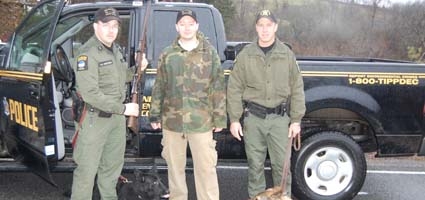
It was a wet first day of opening deer season, and I was soaked by 8:30 a.m. as I stood standing in the rain talking with four conservation officers and three hunters.

One of them was a 17-year-old kid, who an hour and a half earlier had been dodging bullets in a hunting accident that left a four-inch red stripe across his swollen calf from a 9 mm rifle round that scraped past.

Most hunters rise before dawn so they can be in peak position when the light first breaks in the early forest morning. Keeping hunters in line means getting up even earlier for Environmental Conservation Officer Brett Armstrong and myself this past Saturday, on the first day of shotgun and rifle deer season.

Unlike most conservation officers, Brett is fortunate because he doesn’t have to work alone. His partner, Nitro, a 5-year-old black German Shepherd, keeps him company.

I was supposed to meet Brett at 6 a.m. ready to go and my original plan was to get up at 5 a.m. But, in reality, I was hauling at about 5:45. Luckily my employment at The Evening Sun has trained my internal clock to a 6 a.m. regimented wake up. Brett told me he had been out since 4.

The first thing the three of us did was travel around the county on the back roads, noting parked cars and properties. “It’s good to know where people are going to be,” said Brett.


While driving around, Brett gave me a crash course on the responsibilities of a conservation authority. There were many, but Brett was kind enough to break it down: “Basically? To protect the natural resources of New York State and to ensure public safety,” he explained.

In addition to regulating, hunting conservation officers are charged with protecting the environment against abuse from both businesses and individuals. Conservation officers possess all the same powers of regular police and then some. While performing their duties, they have a degree of leeway in crossing private property that regular law enforcement might be restricted from doing, explained Armstrong.

“I don’t see how we could ever do our job if we weren’t able to go where potential offenders will be,” he said.

Hunters are supposed to go by the calendar and wait for dawn to begin shooting – and on Saturday dawn was scheduled to arrive at 6:53 a.m. It was about 6:30, and I was standing alongside Brett at Lyon Brook State Forest as he inspected licenses and exchanged friendly conversation with some hunters. He was always looking for the opportunity to offer a safety tip when the chance casually arose. “Don’t forget to tag your kill as soon as you can,” or “I think dawn will be here at about 6:53 or so,” and so on.

Brett said he wasn’t nervous about the firearms people often carried. “They’re engaging in a legal activity with a firearm. Most people we deal with are good, law abiding citizens that have just made a mistake or didn’t know what they were doing was against the law,” he said.

With more than 20 minutes to go before dawn, we heard our first shot ring out from an overcast, foggy and darkly wooded area. The single shot was off in the woods, but Brett said it was fairly close. Instead of tracking around in the forest where dozens of hunters were just waiting for first light, we staked out the road and waited for the illegally shot deer to be dragged out. Brett explained that officers were trained to determine the time of death of a kill based on its muscle responses.

Discuss this story with other members on the Forum


There's more to this story! You're only seeing 44% of the story. Subscribe now to get immediate access to the rest of the story as well as our whole online offering.

Today's Other Stories


Reader Response

Be the first to comment on this story.

Please log in to leave a comment.
© 2009 Snyder Communications/The Evening Sun
29 Lackawanna Avenue, Norwich, NY 13815 - (607) 334-3276