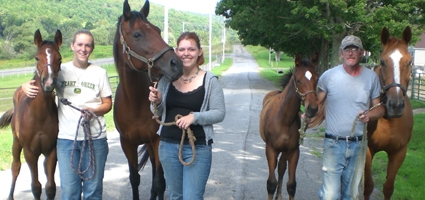
Every day I drive past the 327 acres that make up Rhapsody Farm, but until last week, I had no idea what kind of work goes into training and selling the Thoroughbred horses, many of which go on to race competitively.
Elaine Peck and her husband Richard Quinn begin work every day at 5 a.m. “Last year, we prepared over 20 horses for Saratoga,” Peck said. “This year we have as many if not more.”
I arrived at Rhapsody Farm in Plymouth at 8 a.m. on the day the horses were being transported to the Fasig-Tipton Saratoga Yearling Sale. Although I missed most of the excitement of the day, Elaine showed me around the property and explained what goes into preparing the horses for the sale.
The horses that go to the yearling sale have to be at the farm 75 to 90 at least days in advance of the August sale, Elaine said. Training begins in May. “We have a controlled regime of exercise,” said Elaine. “We want the yearlings to peak mentally and physically at the time of the sale.” As with any training regiment, the daily nutrition and exercise of each horse is monitored, and the staff at the farm watch each horse to determine if there is a serious change in their behavior that might indicate a potential problem. The farm has decreased the number of horses prepared for each sale, Peck said, in order to maintain a better knowledge of each individually. “If the number of animals is too high, you could tend to lose track of the individual. You have to know what’s normal to know what’s not normal.”
“The horses that are raised here, seem to be easier,” Elaine said. “Whether it be that we know them better or we’re in control since birth.”
During the course of the day, the employees at Rhapsody Farm are responsible for exercising the horses, and bathing them once they’re done, feeding the horses and cleaning up the pastures and the stalls. Along with this there are extensive hours of grooming, of which Elaine says her husband is the key person. “This time of year, we start at 5 a.m., take a break in the afternoon, come back for night chores at 5:30 or 6 and work until approximately 9 p.m., sometimes later,” Elaine said. “During foaling season, you could be working anytime, day or night.”

There's more to this story! You're only seeing 51% of the story.
powered by