Natural gas meeting draws 600-plus

NEW BERLIN – What New York state’s natural gas pioneer William Hart started back in the 1820s in Chautauqua County is finally coming full circle, having arrived on the doorstep of unsuspecting landowners in the Southern Tier.

Hart’s first successful natural gas well was drilled in Fredonia and led to further interest in the rock formations underground elsewhere in the state. Later, Allegheny County witnessed the first successful oil boom in the town of Richburg. Called the “Glory Year,” in 1881, the boom gorged the town’s minuscule population of 100 to 7,000 in just nine months.

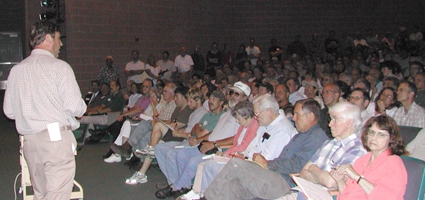
This history and more – including an extensive scientific description of the geology underground here and the ins and outs of negotiating leases – was described in a three and a half hour-long presentation last evening at the Unadilla Valley High School, sponsored by the Central New York Landowner’s Coalition.

Four speakers, a geologist, an energy research provider, environmental regulator and lawyer, were on hand to describe the reality of what has become a frenzy of natural gas interest in Chenango County.


Geologists have widely known and recorded New York’s rich store of mineral deposits and both natural gas and oil well production in the state has ebbed and flowed, with oil peaking in 1878. Today, there are 75,000 oil and gas wells in the state, with about 10 to 12,000 producing. There were significant natural gas production spikes in a two time periods in the mid-1900s, but nothing like what the region’s landowners have been experiencing: the newfound interest in the Marcellus Shale.

According to the experts, natural gas industry companies are planning to invest approximately $1 billion over the next two years in New York. “This is just getting going,” said John P. Martin, senior project manager for the New York State Energy Research and Development Authority. The public authority’s job is to transfer technology information to the public, conduct research and act on energy problems on behalf of the state.

All of the newfound interest in the Marcellus Shale began last September when geologist Richard Nyahay, who spent two years researching for the New York State Museum, calculated the potential quantity and quality of the formation.

“A lot of eyes in the nation are beginning to focus on your areas in upstate New York,” he told the more than 600 landowners in attendance last night.

Nyahay said he began his research by focusing on the Barnett Shale formation in Texas and comparing it to the Marcellus. The Barnett Shale, he said, has been the most successful shale play in the nation, but it took experts 17 years and 130 wells before finding that success.

Discuss this story with other members on the Forum


There's more to this story! You're only seeing 41% of the story. Subscribe now to get immediate access to the rest of the story as well as our whole online offering.

Today's Other Stories


Reader Response

Be the first to comment on this story.

Please log in to leave a comment.
© 2008 Snyder Communications/The Evening Sun
29 Lackawanna Avenue, Norwich, NY 13815 - (607) 334-3276