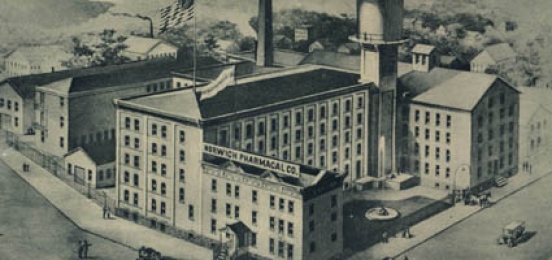
With the continued progress and growth of this young company, a native of Norwich, 38-year-old Robert Dennison Eaton, purchased in 1892 a quantity of preferred stock in the corporation. R.D. Eaton, a graduate of the old Norwich Academy (located on the site of the Chenango County Office Building) was already a successful businessman, being owner of the R.D. Eaton Grain & Feed Company which was located on East Main Street, which was destroyed by fire, and was the location of the former Victory Markets, now the P&C Plaza. Eaton saw great possibilities for the “pharmacy” and foresaw that it would eventually be a great asset to the community. With these possibilities at hand, he became actively engaged in the business and on Dec. 13, 1892 he was named inspector of elections for the new corporation. By the year 1901, Eaton was appointed a member of the board of directors and its salary at a salary of $5 weekly. Being a man of ideas and with business knowledge, his plan was to mold the progress that would eventually see this young corporation grow to become a leader in its field before his death.
During these early years. Dr. Jeffrey continued to watch the progress of Oscar Bell’s enterprise with keen interest. His medical practice kept him busy (being a prominent nose and throat specialist) he continued to have contact with Bell and quite frequently discussed business matters with him. Sometime during these early years Dr. Jeffrey brought to Bell a medical formula to see if Bell could sell this formula commercially. This secret formula which had been in the Jeffrey family for a number of years, was given to his grandfather, Dr. Samuel Jeffrey in 1827 or 1828 (there are two dates in given in this research) by Sir Astley Cooper, famous English surgeon, when the former left England for the Unites States. Dr. S. Jeffrey settled in Geneva, making and selling this ointment, changing the name from “Cooper’s Alum Ointment” to “Jeffrey’s Universal Family Ointment,” packaging it in one ounce tin boxes and selling it for $.25 each. Dr. Jeffrey would continue to make and sell the product until his death which occurred sometime during the Civil War. With his death the formula had remained with the Reverend Reuben Jeffrey until his son Dr. Samuel Jeffrey approached Bell.
Being sworn to secrecy, Bell began experimenting with the ointment, failed to come up with a workable formula, making the statement to Dr. Jeffrey, “It’s a splendid ointment, but no one can make the stuff so that it will be marketable.” Bell realizing the problem proceeded to retain R.C. Stofer, a chemist, and obtaining permission from Dr. Jeffrey to extend the pledge of secrecy to Stofer so that he might continue the investigation for a commercial formula. With what we will assume as extensive research, Stofer succeeded in perfecting the formula and in March of 1893 Dr. Jeffrey was the recipient of the first contract for the new ointment. Dr. Jeffrey, though not a member of the organization, was to receive royalties on the sale of the new product.
As time passed and the product became ever more popular, the decision was made that this product should have a new name. Derived from the Latin word “unguentum” meaning ointment, the name of “Unguentine” was created. Dr. Jeffrey was quoted later as saying that it was the first ointment on the market for use as a pharmaceutical preparation. Success with the new product proved to be beneficial for in 1894 the first advertisement for “Unguentine” was used with the slogan “Without a Scar.”

There's more to this story! You're only seeing 41% of the story.
powered by