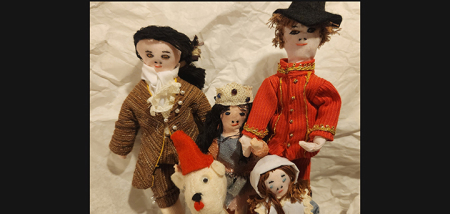
Santa and his bevy of ... ruminant beauties?

There's a growing movement by some feminists to alter what has been a traditional Christmas theme for many decades. It has even been circulating on the Internet, but in a good-natured way. It has to do with Santa's reindeer. You know, Comet and Cupid, Donner and Blitzen, et al. Even Rudolph, that cherry-nosed ruminant that Claus uses on foggy Christmas Eves, has come into question. And technically, though I hate to admit it, the questioning women are right.

You see, reindeer are a member of the deer family, all of which see the males grow a set of antlers, starting in the spring, and normally shedding them in early winter. But unlike other deer, reindeer and their kissin' cousins, caribou, see both males and females grow antlers. However - and here's the problem - the females retain their antlers until the following summer, presumably to protect their newborn calves from predators. So the feminists' claim is that all those eight reindeer (we assume Vixen is female) hauling Santa's heavy sled must be females, since males would have shed their antlers by Christmas.


Now when Clement Clarke Moore penned that famous poem "Twas The Night Before Christmas" (some historians believe the poem was actually first written by Major Henry Livingston, Jr), and it was first published in the Sentinel, a New York newspaper on December 23, 1823, I seriously doubt that Clement (or the Major) had ever actually seen a reindeer or knew much about them. Fact is, even today, few people know much about reindeer, so here's a bit of information for their edification.

Domesticated reindeer are found in Scandinavia. Russia and North American, and wild reindeer are primarily found in Norway, North America, and Greenland. Wild caribou and domestic reindeer are considered to be a single species throughout the world, but wild caribou tend to be larger than the domestic reindeer. Current estimates of the domestic reindeer population worldwide is over a million animals. These deer are used as draft animals and also for food and clothing items.

Caribou, such as those seen on the Discovery or Nature channels, roam in huge herds throughout the tundra regions of North America. Estimates of 400,000 to 600,000 caribou make up the Beverly and Qamanirjuaq herds that inhabit the Northwest Territories, northern Saskachewan and northern Manitoba. The Western Arctic Herd of Alaska contains about a half million animals, while the Quebec-Labrador herds total more than a million. There are also Woodland caribou, a slightly different animal that inhabits remote northern woodlands rather than tundra. The Woodland variety is not as plentiful.

Discuss this story with other members on the Forum


There's more to this story! You're only seeing 46% of the story. Subscribe now to get immediate access to the rest of the story as well as our whole online offering.

Today's Other Stories


Reader Response

Be the first to comment on this story.

Please log in to leave a comment.
© 2008 Snyder Communications/The Evening Sun
29 Lackawanna Avenue, Norwich, NY 13815 - (607) 334-3276