PLYMOUTH – Plymouth farmer Giff Foster has no problem visualizing the big picture. He just needs a little help putting the actual puzzle together so everyone can see what a clean and energy efficient world really looks like.
He already sees a similar one every day.
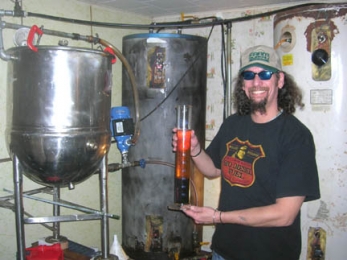
That’s because Foster produces and consumes between 65 to 75 gallons of alternative energy (in the form of biodiesel) per week at his home on “Foggy Bottom Farm.” The semi-retired rock musician and 30-year veteran of the entertainment industry heats his home, runs his farm equipment, and fuels his vehicles using leftover deep-fryer oil, which he collects from restaurants in Chenango County and Connecticut. Whether it’s by travel or experiment, he says searching-out new – and practical – uses for otherwise wasted resources, like old vegetable oil, is the main idea behind developing alternative energy.
“It’s just like Jerry Garcia said,” Foster explained, referring to a famous lyric sung by the legendary and deceased member of the Grateful Dead. “One man gathers what another man spills.”
With his own micro-refinery – a clever system of barrels, tanks, gauges, pipes and tubes in the back of his house – Foster has not only been able to create a versatile and clean energy source for his farm, but also nutrient-rich fertilizers for his hay and apple crops as well. He recently added a glycerin-based soap to his list of products-made-from-bi-products, and says that creating high-grade animal feed is another conceivable possibility.
“We are turning waste into energy,” he said. “And there is nothing in the biodiesel process that’s a wasted product.”
The inspiration for his full-circle frame-of-mind came two-years ago when he encountered the economic reality check that is being a Chenango County farmer, Foster said.
“I knew I couldn’t make this farm work with these costs,” he said, talking mainly about fuel prices. “I didn’t prepare for the challenge ... I had to do something about it.”
The answer was “transesterification,” an acid-based reaction that creates biodiesel. It occurs when filtered vegetable-oil, whether it’s from a restaurant or a plant – is mixed and heated with the chemical lime and an alcohol-based catalyst, such as methanol or ethanol. Foster said it seemed like the most advantageous way to conserve and re-use, after considering and comparing other options such as wind and solar power.

There's more to this story! You're only seeing 46% of the story.
powered by