Indian Burial Grounds?
Published:
February 19th, 2007
By:
Donald A. Windsor
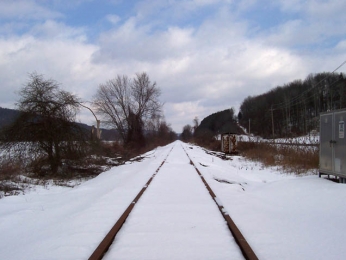
See those railroad tracks in the photo? They belong to the New York, Susquehanna & Western Railroad (NYS&W), formerly the Delaware, Lackawanna & Western Railroad (DL&W). They traverse the flat land of the Chenango River valley. Their railbed was laid down around 1870, long before we had any systematic archaeological investigations here. Our local archaeological group was started in 1950.
Since then, dozens of sites along the river and the railroad have been reported. The overall consensus is that the land everywhere along the Chenango River was used by the Native Americans for thousands of years.
Consequently, the chances are pretty good that the railroad was laid over many sites, some of which could have been burial grounds. Actually, the railbed is preserving these possible sites by preventing anyone from disturbing them.
If the New York Regional Interconnect (NYRI) installs a powerline along these tracks, it will have to drastically disturb the railbed as well as the ground under and around it to construct foundations for the huge towers.
Author: Donald A. Windsor - More From This Author
Comments