The Hosea Dimmick house

“The stone that was rejected by the builders has become the cornerstone.” So says Psalm 118:22, one of my favorite biblical passages, because it dangles hope for all of us struggling artists. Perhaps, just perhaps, after a lifetime of rejections, there may finally be a triumphant acceptance.

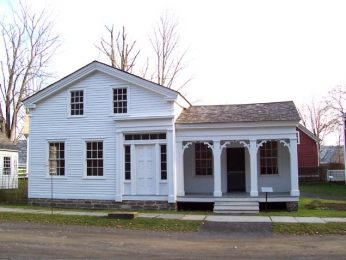
That neat, white house in the photo was rejected by the builders of the new YMCA in Norwich. It once stood at 21 Mechanic Street, near the northeast corner of what used to be the Turner Street intersection. It was in the way of the developers and faced imminent destruction. However, it was rescued by a team of local saviors and donated to the Farmers’ Museum in nearby Cooperstown. It now proudly stands on the northeast corner of Main Street and Schoolhouse Lane in the museum’s Pioneer Village. It may not be the cornerstone of that interesting place, but it sure fits in well. This village showcases buildings from the 1840s.


The brass plaque in front of the building reads: “Hosea Dimmick House, Norwich, Chenango County, New York, 1845. This house was built in Norwich, Chenango County, New York, in 1845. The architecture is an example of Greek Revival, with the gable end of the main block of the house positioned toward the street and a smaller wing set perpendicular to it. This style of house was so popular in the mid-19th century that examples can be found in almost every village and town in central New York.

“Hosea Dimmick purchased the house in 1853 from Samuel Per Lee, who most likely built the house in 1845. It remained in Dimmick’s family for three generations. Dimmick was the lock tender for Lock #93 on the Chenango Canal, which was just down the street from the house. Canals transformed the economy of the state by greatly reducing the cost of transporting farm products and other raw materials.

“The house was moved in four pieces to The Farmers’ Museum in 2000. It is being restored to represent a typical middle-class home in central New York. The Hosea Dimmick House was donated to The Farmers’ Museum by the YMCA of Norwich, New York.”

Not only did the YMCA donate the house, but I heard that it also donated a substantial amount of money for the transportation.

Discuss this story with other members on the Forum


There's more to this story! You're only seeing 42% of the story. Subscribe now to get immediate access to the rest of the story as well as our whole online offering.

Today's Other Stories


Reader Response

2 comments on this story

Dolores
March 31st, 2007 at 12:24 am
23 Mechanic St,was my husbands home in his teen years, The Jaycox family lived there until my mother in law Bertha Jaycox passed.Then the Y took it over. But whenever we went up north, we visited Mrs Jennings beautiful home until her death. She lived in the Hosea Dimmick house, next door.The window shades were handpainted.

I wish I could read the whole article as 23 Mechanic st was taken apart also and was to be erected at Cooperstown also, but I hear they sent pieces out to the N Y Historical Society.

I will forward this to my children and grandchildren.
howiebread
February 6th, 2007 at 7:44 am
My great grandmother, Mary Sullivan, died in this house. I was the lead person for the Y with the Farmer's Museum. The house to the east was also taken and I beleive that they (FM) have the historical parts. That house was occupied by Mr. Jaquay who now lives on the northeast corner of Grove Ave and Maydole. It was not reassembled. The Y was very pleased with the outcome. I remember going to the Dimmick house with my grandmother. I think Sophia Jennings lived there at the time. According to my grandmother it was a great treat to sit, have tea and look at the beautiful wallpaper. At about age 5 or 6 I had a different opinion.
Please log in to leave a comment.
© 2008 Snyder Communications/The Evening Sun
29 Lackawanna Avenue, Norwich, NY 13815 - (607) 334-3276