By Audrey Robinson
NECCM Education Committee
The mission of the Northeast Classic Car Museum consists of educating the public on different aspects of the automobile and its history throughout the years. Much of what the Museum offers intertwines with the criteria that can be assimilated with the New York State Learning Standards. The goal of the Museum is to offer the experience of a visit to the NECCM as a medium to cultivate an interest in history, literature, science, math and technology. This is the first article in a series of 5 that will be published in The Evening Sun to celebrate National Education Week. Student admission from November 12-18, 2006 is $2.50.
The automobile flashed onto the scene like a meteor, changing the entire economy and the national way-of-life. No one was prepared for it. Generations of horse-drawn road transportation had created a complex system of industries on which the automobile had a damaging effect. The continuing changes and reasons for them were not so obvious to automotive pioneers. It was, after all, a learn-as-you-go process with no precedents.
Automotive history is generally divided into a number of eras based on the major design and technology shifts. Although the exact boundaries of each era can be hazy, they can be defined as follows: Veteran era (1800-1900), Brass era (1903-1920), Vintage (1919-1929), Pre-War (1930-1948), Post-War (1949-1970) and Modern (1970-on). Corresponding historical periods were: The Development of Modern America (1865-1920); Modern American and the World Wars (1914-1945) and Contemporary America (1945 to the present).
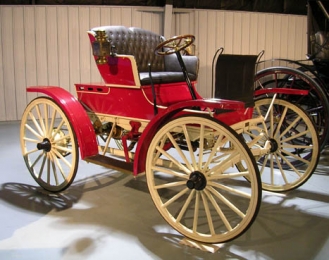
By 1900 mass production of automobiles had begun in France and the United States. Throughout the veteran car era automobiles were seen as more of a novelty than a genuinely useful device. Breakdowns were frequent, fuel was difficult to obtain, and rapid innovation meant that a year-old car was nearly worthless. New York became the first state in the US to require automobile license plates in April of 1901. Automobile owners were charged a fee of $1.
Named for the widespread use of brass in the United States, the Brass or Edwardian era lasted from roughly 1905 through the beginning of World War I in 1914. 1905 was a signal year in the development of the automobile, marking the point when the majority of sales shifted from the hobbyist and enthusiast to the average user. Cars of the period include the Ford Model T, the most widely produced and available car of the era. There were, however, scores of other small, start-up manufacturers (often businesses that made buggies and carriages) that started making automobiles.

There's more to this story! You're only seeing 49% of the story.
powered by